The Quiet Revolution
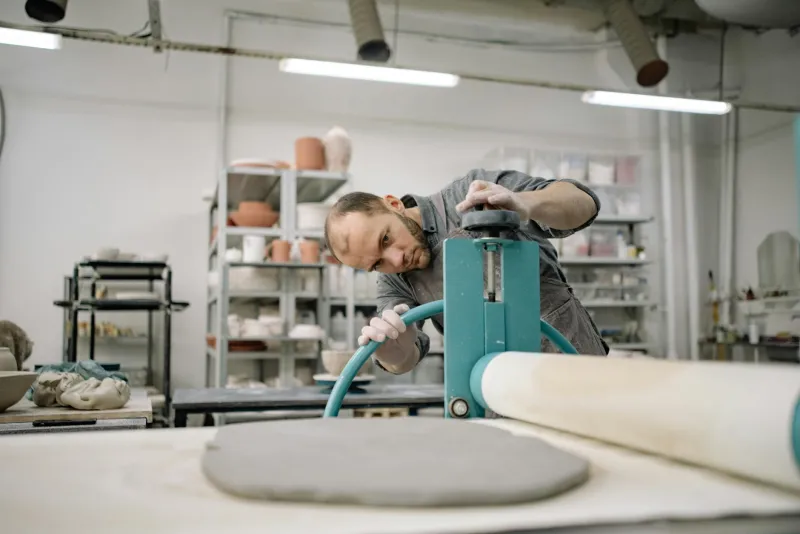
In a converted Victorian mill in Leeds, Sarah Chen kneads clay with the same intensity that previous generations reserved for political manifestos. Her hands shape vessels that will never hold water, creating forms that exist purely to interrogate our relationship with consumption, identity, and place. Chen represents a movement of British ceramicists who have transformed pottery from domestic craft into cultural weapon.
This isn't your grandmother's pottery class. Across Britain's creative hubs, a cohort of makers born into the digital age are returning to one of humanity's oldest technologies, wielding clay as both medium and metaphor. Their work emerges from studios in Glasgow's Merchant City, Bristol's Stokes Croft, and Manchester's Northern Quarter—spaces where rent remains just affordable enough for experimentation, where community still trumps commercialisation.
Beyond the Wheel
The traditional potter's wheel, that symbol of meditative craft, has been joined by 3D printers, laser cutters, and digital archives. Emma Rodriguez, working from her Hackney studio, creates vessels that appear hand-thrown but incorporate QR codes fired into the glaze. Scanning these codes reveals audio recordings of immigration interviews, transforming each piece into a repository of human experience.
"Clay remembers everything," Rodriguez explains, her fingers stained with iron oxide. "Every pressure, every temperature change, every moment of tension. It's the perfect medium for holding memory—personal and collective."
This synthesis of ancient technique and contemporary technology characterises much of the movement. In Glasgow, collective 'Fired Earth' combines traditional Scottish pottery methods with data visualisation, creating pieces that translate climate data into physical form. Their latest series, 'Rising Waters', features vessels whose glazed surfaces map sea-level projections for British coastal towns.
The Politics of Making
What distinguishes these makers from previous craft revivals is their explicit engagement with political discourse. Where earlier pottery movements often retreated into romantic notions of pre-industrial simplicity, this generation confronts complexity head-on.
James Morrison, whose Bristol workshop occupies a former bank building, creates pieces that critique Britain's financial systems. His 'Currency' series features ceramic coins embedded with actual copper pennies, questioning the arbitrary nature of value. The pieces cannot be spent, cannot be saved, existing in the liminal space between art object and social commentary.
"We're not escaping into craft," Morrison argues. "We're using craft to engage more deeply with the world we've inherited."
This political consciousness extends to the makers' chosen working methods. Many operate as collectives, sharing resources and knowledge in explicit rejection of the isolated artist model. The 'Clay Commons' movement, with chapters in six British cities, provides shared studio space, communal kilns, and skill-sharing workshops—creating infrastructure for cultural production outside traditional commercial galleries.
Material Anxiety
The choice of clay itself carries significance. In an era of planned obsolescence and digital ephemerality, these makers have chosen a medium that endures. Ceramics survive civilisations; smartphones barely survive contracts. This temporal durability allows the work to function as time capsule, preserving contemporary anxieties in fired earth.
Lydia Okafor, whose Manchester studio specialises in 'anxiety vessels', creates pieces that physically embody psychological states. Her depression bowls feature interiors so dark they seem to absorb light, while her anxiety vases incorporate textured surfaces that compel touch—then fragment at human contact.
"We're living through multiple crises simultaneously," Okafor notes. "Brexit, climate change, digital overwhelm, housing insecurity. Traditional vessels held water, food, wine—substances that sustained life. My vessels hold the emotional reality of trying to sustain life now."
The Gallery Underground
These makers are also redefining exhibition spaces. Rather than seeking validation through established galleries, many create their own presentation contexts. Pop-up shows in derelict buildings, installations in working pottery studios, and pieces integrated into public spaces—all serve to democratise access to their work.
The 'Shard & Share' collective, operating across London's outer boroughs, places ceramic works in launderettes, corner shops, and bus stops—spaces where communities actually gather. Their 'Everyday Monuments' project replaces broken street furniture with ceramic alternatives, each piece documenting the specific social challenges facing that neighbourhood.
Firing the Future
This movement's significance extends beyond art world recognition. By combining traditional craft skills with contemporary critical thinking, these makers offer a model for cultural production that values both technical excellence and social engagement. Their work suggests possibilities for creative practice that neither retreats from contemporary challenges nor surrenders entirely to market forces.
As Chen loads her latest pieces into the kiln, she reflects on clay's transformative properties. "Fire changes everything irreversibly. You can't undo the process, can't return to the original state. That's what we're documenting—the irreversible changes happening to our society, our environment, our sense of who we are."
In workshops across Britain, kilns are firing not just clay, but cultural commentary. These makers have discovered that the oldest human technology might also be one of the most radical—a medium that allows for both preservation and transformation, tradition and critique, beauty and politics. Their quiet revolution continues, one fired vessel at a time.