The Weight of Words
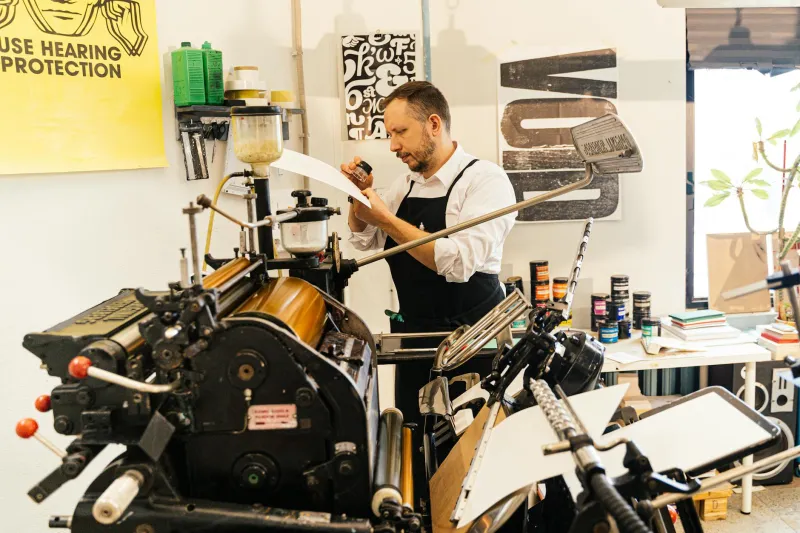
In a converted railway arch beneath London's Bermondsey Street, the rhythmic thrum of a 1960s Heidelberg press punctuates the morning air. Sarah Chen adjusts the ink distribution on her forme—a carefully composed arrangement of metal type that will soon birth fifty copies of a limited-edition poetry chapbook. Each impression carries the subtle imperfections that no digital process can replicate: the slight bite of metal into cotton paper, the whisper-thin variations in ink density that speak of human hands guiding mechanical precision.
Chen represents a quietly flourishing movement across Britain, where typographers, calligraphers, and letterpress artisans are reclaiming the written word from digital uniformity. This renaissance extends far beyond mere craft revival—it constitutes a philosophical challenge to our relationship with language itself, questioning whether words lose meaning when stripped of physical weight and temporal investment.
The Geography of Craft
From Edinburgh's cobbled Royal Mile to Bristol's industrial quarter, these contemporary scriptoriums occupy spaces that themselves tell stories of transformation. In Glasgow's Merchant City, letterpress collective The Paper Tiger operates from a former Victorian warehouse, their Vandercook proofing press sharing space with collaborating bookbinders and printmakers. The environment reflects their ethos: industrial heritage repurposed for artisanal futures.
James Morrison, who established his calligraphy practice in a converted barn outside Bath, describes the spatial requirements of his craft with particular eloquence. "Calligraphy demands contemplation," he explains, gesturing towards his collection of reed pens and handmade inks. "You cannot rush the formation of letters when each stroke carries the weight of centuries of tradition. The space itself must accommodate this temporal expansion."
This geographical distribution reveals something significant about contemporary British craft culture. Rather than concentrating in traditional creative capitals, these artisans seek spaces where rent remains affordable and community connections run deeper. Their practices often involve extended apprenticeships, collaborative workshops, and the slow accumulation of vintage equipment—economic models that resist the accelerated pace of urban creative industries.
The Paradox of Digital Natives
Perhaps most intriguingly, many practitioners entering this field represent the first generation to grow up entirely within digital communication environments. Emma Rodriguez, whose hand-lettered wedding invitations command premium prices across the Home Counties, describes her journey from graphic design to calligraphy as "an awakening to texture."
"I spent my twenties manipulating Helvetica and Futura on screens," Rodriguez reflects. "But there's something profound about feeling paper grain beneath your nib, about understanding how ink flows differently across various surfaces. It's sensory information that digital typography simply cannot convey."
This generational shift challenges assumptions about technological adoption. Rather than abandoning digital tools entirely, these artisans employ them strategically—using social media to showcase their work, digital photography to document process, and online platforms to connect with clients who specifically seek alternatives to mass-produced design.
Cultural Resistance Through Craft
The political dimensions of this movement extend beyond aesthetic preference. In an era where artificial intelligence generates convincing text and automated systems compose marketing copy, the deliberate choice to form letters by hand becomes an act of cultural resistance.
Dr. Margaret Sinclair, who researches craft movements at the University of Edinburgh, positions this revival within broader patterns of response to technological acceleration. "These practitioners aren't Luddites," she emphasises. "They're making sophisticated choices about which aspects of technological capability to embrace and which to consciously reject. The letterpress artist who spends three hours setting type for a single page isn't inefficient—they're prioritising different values entirely."
This resistance manifests in commercial terms as well. Clients commissioning hand-lettered signage for boutique hotels or bespoke invitations for milestone celebrations explicitly seek the visual markers of human labour. The slight tremor in a hand-drawn baseline, the microscopic variations in ink saturation—these "imperfections" command premium pricing precisely because they cannot be replicated through industrial processes.
The Economics of Intention
The financial sustainability of these practices reveals changing consumer priorities within certain market segments. Rebecca Walsh, whose Edinburgh-based calligraphy studio maintains an eighteen-month waiting list, charges rates comparable to established graphic design consultancies. Her clients—ranging from luxury hospitality brands to private collectors commissioning illuminated manuscripts—view her work as investment in cultural authenticity.
"People understand that genuine craft requires time," Walsh explains. "When someone watches me spend six hours lettering a single poem, they're witnessing value creation that extends beyond the final product. They're purchasing process as much as outcome."
This economic model challenges conventional creative industry assumptions about efficiency and scalability. These artisans deliberately limit output to maintain quality standards and preserve the meditative aspects of their practice. Their success suggests market appetite for alternatives to mass-produced design, particularly among demographics seeking meaningful connections to material culture.
The Future of the Written Word
As Britain's hand-lettering community continues expanding, questions emerge about tradition, innovation, and cultural continuity. These practitioners study historical exemplars—medieval illuminated manuscripts, Victorian commercial lettering, modernist typography—while developing contemporary voices that speak to current cultural moments.
The movement's significance extends beyond preserving traditional crafts. By insisting on the continued relevance of slow, deliberate making in an accelerated world, these artisans offer alternative models for creative practice itself. Their work suggests that the future of design might involve not just technological advancement, but conscious choices about which aspects of human capability deserve preservation and celebration.
In their converted railway arches and repurposed barns, Britain's new scriptoriums continue the ancient dialogue between hand, tool, and meaning—ensuring that words retain their weight in an increasingly weightless world.