The Militant Thread: How Britain's Embroidery Rebellion is Stitching Together Political Resistance
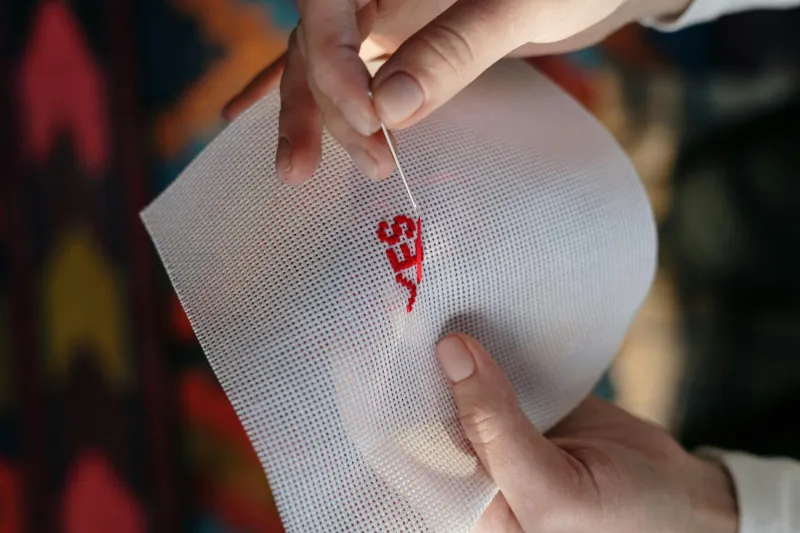
In a converted Victorian mill in Manchester, Sarah Chen draws her needle through canvas with the precision of a surgeon and the fury of a revolutionary. Her latest piece—a delicate French knot rendition of Grenfell Tower engulfed in flames—sits alongside works depicting foodbank queues rendered in silk thread and climate protesters embroidered in metallic gold. This is not your grandmother's needlework.
The Quiet Insurrection
Across Britain, a movement is emerging that weaponises the most feminine and domestic of crafts. These artists are not merely decorating; they are documenting, protesting, and fundamentally challenging the relationship between craft and commentary. The embroidery hoop has become a frame for rage, and the needle a pen dipped in political ink.
The movement's roots trace back to the 2008 financial crisis, when austerity measures began biting into the fabric of British society. As traditional forms of protest faced increasing surveillance and criminalisation, artists began turning to what appeared to be the most innocuous medium possible. Who would suspect sedition in a sewing circle?
"There's something beautifully subversive about using the tools that once kept women quiet to now make them heard," explains Dr. Rebecca Martinez, curator of contemporary textile arts at the Whitworth Gallery. "These artists are exploiting the cultural blind spot around domestic crafts. People see embroidery and think 'harmless hobby,' but these works are anything but harmless."
Needles as Weapons
The technical mastery required for political embroidery creates an interesting paradox. Each stitch demands patience, contemplation, and time—the very antithesis of our rage-tweet culture. Yet this slow, meditative process allows for a different kind of political expression, one that builds intensity through accumulated detail rather than explosive gesture.
London-based artist Priya Patel has spent three years creating "Hostile Environment," a series depicting the faces of deportees worked entirely in black thread on white linen. The cumulative effect is haunting—each face requires approximately forty hours of work, making the labour itself a form of memorial. "The time investment forces viewers to consider the individual human cost," Patel notes. "You can't scroll past this the way you might scroll past a news headline."
The movement has found particular resonance in Britain's post-industrial communities, where traditional manufacturing has given way to precarious service work. In former textile towns across Lancashire and Yorkshire, community groups are teaching embroidery as both therapeutic practice and political education. The Blackburn Collective, founded by former mill worker Janet Thompson, runs workshops that combine basic stitching techniques with discussions about workers' rights and economic inequality.
Gallery Recognition
What began in community centres and online forums has increasingly gained institutional recognition. The Tate Modern's recent acquisition of works by the Birmingham-based Threads of Resistance collective marks a significant moment for the movement. These pieces, which document police brutality through intricate beadwork and silk painting, represent the first overtly political textile works to enter the Tate's permanent collection since the suffragette banners of the early twentieth century.
Yet this mainstream acceptance brings its own tensions. Critics within the movement argue that gallery exhibition risks neutering the radical potential of the work, transforming tools of resistance into objects of aesthetic contemplation. "There's always the danger that once something enters the white cube, it becomes safe," warns Manchester-based artist collective Stitch & Resist. "Our work was born in kitchens and community halls. That's where its power lies."
Digital Dissemination
The internet has proved crucial to the movement's development, with Instagram and TikTok serving as virtual galleries for politically charged needlework. The hashtag #ResistanceEmbroidery has generated over 50,000 posts, creating a global community of practice that transcends geographic boundaries. British artists regularly collaborate with counterparts in the United States, Chile, and Hong Kong, sharing techniques and political strategies.
This digital dimension has also enabled new forms of collective action. During the 2019 climate protests, embroidery groups coordinated to create hundreds of identical pieces—simple white flowers with the words "Extinction Rebellion" worked in green thread. These were distributed at protest sites across London, creating a visual language that was simultaneously beautiful and defiant.
The Craft of Resistance
Perhaps most significantly, these artists are fundamentally altering how we understand the relationship between craft and politics. By insisting on technical excellence alongside political content, they reject the false binary between aesthetic and activist practice. Their work demands to be taken seriously on both counts—as craft and as commentary.
The movement's success lies partly in its ability to make the political personal and the personal political. In an era of algorithmic news feeds and manufactured outrage, these artists offer something different: a form of resistance that is intimate, considered, and enduring. Each piece carries within its fibres not just political message but also the time, care, and skill of its maker.
As Britain continues to grapple with questions of identity, inequality, and environmental crisis, these textile rebels provide a model for engaged citizenship that is both ancient and urgently contemporary. They remind us that the most powerful revolutions often begin not with manifestos or marches, but with individuals, working quietly and persistently, stitch by stitch, to create the world they wish to inhabit.
In their hands, the needle becomes mightier than the sword—or at least, more subversive than anyone ever imagined possible.