The Last Brushstrokes of Britain
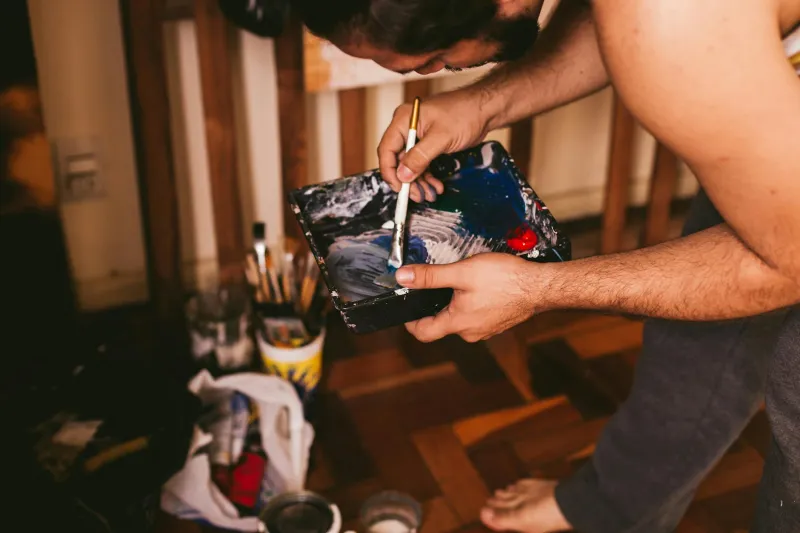
In a converted stable behind The Red Lion in Hertfordshire, Malcolm Stringer dips his brush into cadmium yellow and considers mortality. Not his own—though at seventy-three, the thought occasionally surfaces—but that of an entire craft tradition stretching back four centuries. The pub sign he's painting, a replacement for storm damage, will likely outlive him. The knowledge required to create it may not survive another generation.
"People think it's just painting," Stringer explains, wiping his hands on a rag stained with decades of pigment. "They don't understand the heraldry, the symbolism, the weight distribution calculations. A pub sign isn't decoration—it's a piece of living history that needs to withstand British weather for twenty years."
Across Britain, fewer than forty traditional sign painters maintain the skills necessary to create hand-painted pub signs. Their workshops—often cramped spaces behind high street premises or converted farm buildings—represent the final repositories of knowledge that once employed thousands.
The Grammar of the Gallows
The pub sign emerged from medieval necessity. When literacy rates languished below twenty percent, visual symbols communicated essential information: the White Hart indicated royal patronage, the Chequers suggested a connection to money-changing, the George and Dragon proclaimed Protestant loyalty. These weren't arbitrary decorations but a sophisticated visual language that organised community life.
"Every element means something," explains Sarah Chen, one of only six women practising traditional sign painting in Britain. Working from her studio in Edinburgh, she specialises in Scottish heraldic traditions. "The crown's position, the lion's stance, even the typeface selection—it all communicates the pub's place in local hierarchy."
Chen learned her craft from Tommy Morrison, whose father painted signs for Glasgow's brewery giants. The knowledge transfer happened through apprenticeship: three years of mixing pigments, preparing surfaces, and absorbing the unwritten rules of composition and symbolism. This oral tradition, she argues, cannot survive digitisation.
"You can't Google how to make gold leaf adhere in Scottish weather," Chen notes, gesturing towards samples that demonstrate different techniques for various climatic challenges. "That knowledge lives in your hands."
Digital Conquistadors
The threat isn't merely technological but economic. Mass-produced vinyl signs cost £200-400, whilst hand-painted alternatives range from £1,500-5,000. For pub chains managing hundreds of locations, the mathematics appears straightforward. Yet this calculation ignores cultural and practical considerations.
"Vinyl lasts five years if you're lucky," argues James Kellaway, whose family business has painted signs across Devon since 1923. "Our work endures decades. More importantly, it connects the pub to its place. Every hand-painted sign reflects local materials, local weather patterns, local aesthetic preferences."
Kellaway's workshop contains signs dating to the 1940s, their paint layers telling stories of restoration and renewal. Examining these archaeological objects reveals techniques lost to contemporary practice: specific lead-based primers that prevented rust, traditional egg tempera that created luminous flesh tones, hand-ground pigments that achieved colours impossible with modern materials.
"The irony," Kellaway observes, "is that pubs desperately want authenticity. They're installing fake Victorian fittings and distressed furniture to create 'character.' Meanwhile, they're replacing genuinely authentic signs with plastic imitations."
The Apprentice Problem
Succession presents the craft's greatest challenge. Traditional apprenticeships require three-year commitments to learn skills with uncertain economic futures. Young people capable of mastering complex artistic techniques often pursue graphic design or fine art careers offering greater financial security.
"I've tried taking on apprentices," admits Robert Walsh, whose Manchester workshop serves pubs across the Northwest. "They see the physical demands—mixing forty-kilogram batches of primer, working outdoors in February, climbing ladders with paint pots—and they reconsider. The romantic notion of craftwork collides with industrial reality."
Yet exceptions exist. In Wales, Gareth Williams represents the craft's younger generation. At thirty-four, he abandoned a marketing career to learn traditional techniques from elderly practitioners. His Instagram account documents the process, attracting international attention to British sign painting traditions.
"Social media helps," Williams acknowledges, "but it can't replace physical mentorship. You need someone watching your brush technique, correcting your colour mixing, teaching you to read wood grain. That knowledge transfer requires presence."
Cultural Cartography
The decline of hand-painted pub signs represents more than aesthetic loss. These objects function as cultural landmarks, encoding local identity in visual form. The Red Lion clustering around coaching routes, the Railway Inn marking Victorian expansion, the New Inn signifying medieval settlement patterns—pub signs create a readable landscape of British social history.
"When you replace hand-painted signs with vinyl versions, you're erasing local distinctiveness," argues Dr. Rebecca Turner, whose research at Cambridge examines vernacular art traditions. "These weren't mass-produced objects but responses to specific places and communities. Their loss homogenises the cultural landscape."
Turner's work documents how traditional sign painters adapted their techniques to local conditions: lighter colours in northern regions to maximise visibility during short winter days, specific mounting systems to withstand coastal winds, particular paint formulations to resist industrial pollution in manufacturing towns.
The Economics of Authenticity
Yet practical considerations cannot be dismissed. Independent pubs operating on narrow margins face genuine financial pressures. The question becomes whether cultural preservation justifies economic burden, and who bears responsibility for maintaining traditional crafts.
"We need new funding models," suggests Chen. "Heritage organisations support building restoration but ignore the craftspeople who maintain those buildings. Sign painting deserves equivalent protection."
Some initiatives offer hope. The Traditional Building Craft Bursary Scheme provides apprenticeship funding, whilst organisations like the Heritage Crafts Association lobby for policy support. Several brewery companies have established heritage programs supporting traditional sign painters.
"It's about recognising cultural value," argues Stringer, returning to his easel. "These signs aren't just business advertisements—they're public art that defines community character. Their preservation benefits everyone, not just pub owners."
As afternoon light fades across his workshop, Stringer continues painting. Each brushstroke represents accumulated knowledge: understanding of pigment chemistry, awareness of weather patterns, appreciation of visual hierarchy. When he retires, this knowledge faces extinction unless transferred to younger hands.
The question facing Britain isn't merely whether traditional pub signs survive, but whether we value the irreplaceable knowledge embedded in traditional craft. In an age of digital reproduction, the hand-painted sign stands as testament to skills that cannot be automated, knowledge that cannot be downloaded, and cultural authenticity that cannot be manufactured.
Their preservation requires recognising that some things, once lost, cannot be recovered.