The Whispered Craft
In a converted stone barn overlooking the Sound of Mull, Margaret MacLeod runs her fingers across the sympathetic strings of a hurdy-gurdy she has spent eighteen months constructing. The instrument, based on fragments discovered in a 16th-century Highland grave, produces haunting drones that seem to emerge from the landscape itself. MacLeod represents a growing movement of British artisans who have dedicated their lives to reconstructing the musical voices of our ancestors.
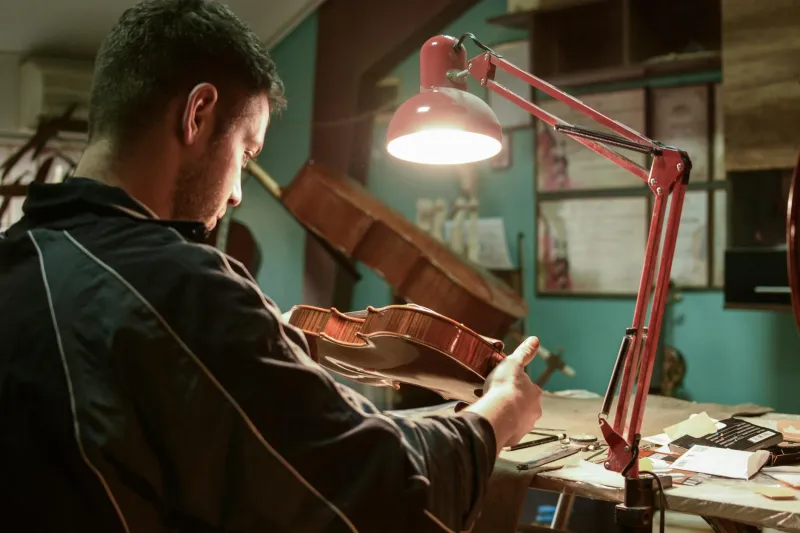
These makers work in profound isolation, often spending years researching a single instrument type through museum archives, archaeological reports, and surviving iconography. Their workshops, scattered from the Hebrides to the Welsh valleys, have become laboratories where historical detective work meets tactile expertise.
Archaeological Symphonies
The revival of Britain's extinct instruments began not in concert halls but in university archaeology departments. Dr. Rhiannon Davies, who splits her time between Cardiff University and her workshop in Snowdonia, explains: "We're not simply copying museum pieces. We're interpreting fragments, understanding construction methods that died with their makers, and making educated decisions about materials and techniques."
Davies specialises in the crwth, Wales's ancient bowed lyre, which disappeared from regular use in the early 19th century. Working from surviving 18th-century examples and medieval manuscript illustrations, she has reconstructed instruments that capture both historical authenticity and contemporary playability. Her crwths now find homes with experimental musicians across Europe who prize their distinctive nasal timbre and percussive possibilities.
The process demands archaeological rigour combined with intuitive craftsmanship. When reconstructing a medieval psaltery discovered during excavations at Warwick Castle, maker James Thornton spent months analysing wood grain patterns under microscopy, identifying the specific Alpine spruce used by 14th-century craftsmen. "The wood tells stories," Thornton observes. "Density variations, growth patterns, even insect damage provide clues about original construction methods."
Contemporary Voices from Ancient Wood
What distinguishes this movement from historical recreation is its embrace of contemporary musical contexts. These instruments are not museum curiosities but active participants in Britain's experimental music scene. Composer Anna Meredith recently commissioned a suite for reconstructed medieval bells and drone instruments, while electronic musician Ben Frost has incorporated MacLeod's hurdy-gurdies into his industrial soundscapes.
The tension between preservation and innovation defines much of this work. Maker Tom Whitwell, whose London workshop produces reconstructed medieval bagpipes, deliberately incorporates modern materials when historical authenticity would compromise musical functionality. "We're not building museum pieces," he argues. "These instruments need to serve contemporary musicians, which sometimes means making historically informed but not historically literal choices."
The Underground Network
These artisans operate through informal networks that span Britain's creative landscape. Information travels through whispered recommendations, workshop visits, and occasional gatherings that feel more like secret societies than commercial enterprises. The Orkney Traditional Music Festival has become an unofficial showcase for these instruments, where makers display their work alongside musicians exploring their sonic possibilities.
Social media has paradoxically strengthened these connections while maintaining their secretive character. Private Facebook groups and Instagram accounts document construction processes, share research discoveries, and coordinate collaborations between makers and musicians. Yet the work itself remains profoundly analogue, rooted in hand tools, traditional joinery, and materials sourced from British forests.
Sonic Archaeology in Practice
The revival extends beyond individual instruments to entire musical ecosystems. In Yorkshire, the Northern College of Music has established a research programme investigating medieval performance practices, using reconstructed instruments to explore historical tuning systems and playing techniques. Students learn to navigate the distinctive intonation of pre-equal temperament scales, discovering sonic territories that modern instruments cannot access.
This archaeological approach reveals how profoundly our understanding of music history has been shaped by surviving instruments. The prevalence of keyboard and string instruments in museum collections, for instance, reflects their durability rather than their historical importance. Wind instruments, percussion, and experimental hybrid forms have largely vanished, taking their musical possibilities with them.
The Future of Ancient Sounds
As climate change and cultural homogenisation threaten traditional craft knowledge globally, these British makers represent a model for cultural preservation through active recreation. Their work suggests that the past's most valuable contributions to contemporary culture may not be its monuments or texts but its technologies for making sound.
The instruments emerging from these workshops carry forward not just historical forms but historical relationships to sound itself. In an age of digital reproduction and global musical standardisation, they offer access to sonic experiences that cannot be replicated through recording or synthesis. They demand physical presence, breath, touch, and the acceptance of imperfection that defines all acoustic music-making.
Through patient research and dedicated craftsmanship, these silent artisans are ensuring that Britain's musical heritage remains not a museum exhibit but a living, breathing part of our contemporary sonic landscape. Their workshops may be isolated, but their influence ripples through concert halls, recording studios, and experimental venues across the nation, carrying ancient voices into an uncertain but sonically richer future.