The Silent Revolution
In a converted Victorian mill in Oldham, the rhythmic clatter of a 19th-century loom mingles with the urgent whispers of contemporary protest. Here, textile artist Zahra Mahmood threads her grandmother's prayer beads into a tapestry that speaks of displacement, belonging, and the fractured narratives of British identity. This is not your grandmother's needlework—this is revolution, one thread at a time.
Across Britain, a remarkable transformation is occurring within the ancient craft of weaving. From the remote crofts of the Outer Hebrides to the repurposed warehouses of Manchester's Northern Quarter, textile artists are reclaiming the loom as an instrument of political expression, cultural critique, and social commentary. What emerges is perhaps the most quietly subversive art movement in contemporary Britain—one that operates beneath the radar of mainstream cultural discourse yet pulses with urgent relevance.
Heritage as Weapon
The tension between tradition and transgression lies at the heart of this movement. In Stornoway, Harris Tweed weaver Aileas MacLeod has scandalised purists by incorporating synthetic fibres sourced from discarded fishing nets into her heritage cloth. Her controversial "Plastic Seas" collection transforms the iconic tweed—symbol of Scottish craftsmanship and rural authenticity—into a meditation on environmental destruction and industrial betrayal.
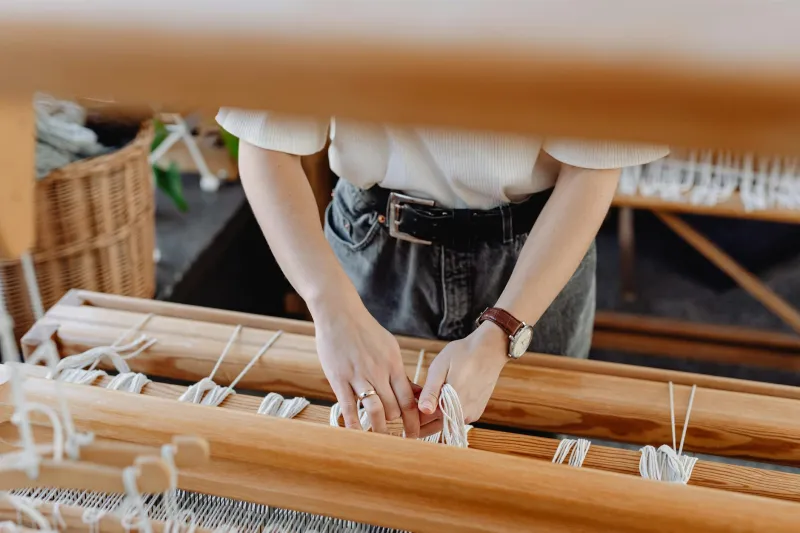
"The loom doesn't distinguish between wool and warning," MacLeod explains, her fingers dancing across the warp threads with practised precision. "Every piece I create carries the weight of what we've lost and the urgency of what we might still save."
This appropriation of traditional techniques for contemporary critique extends far beyond Scotland's shores. In Birmingham's Jewellery Quarter, the Midlands Loom Collective—a group of predominantly young, ethnically diverse artists—has established itself as a provocative voice in Britain's cultural conversation. Their collaborative works weave together found materials from the city's industrial heritage: copper wire from demolished factories, silk from abandoned sari shops, cotton from the remnants of Britain's textile empire.
The Politics of Thread
The political dimension of this textile renaissance cannot be understated. These artists understand that weaving, historically the domain of women and marginalised communities, carries inherent subversive potential. The domestic craft becomes public statement; the private labour transforms into collective resistance.
Consider the work of Cardiff-based artist Bronwen Davies, whose monumental installation "The Unravelling" occupied the entirety of Chapter Arts Centre's main gallery last autumn. Constructed from thousands of metres of red thread—each strand representing a public service cut since 2010—the piece created a labyrinthine environment that visitors could only navigate by literally cutting their way through the accumulated losses of austerity Britain.
"Weaving is inherently political," Davies argues. "It's about connection, structure, the tension between individual threads and collective strength. When I work with textiles, I'm working with the fundamental metaphors of social organisation."
Institutional Recognition
The art establishment has begun to take notice. Tate Modern's recent acquisition of three major textile works signals a shift in institutional attitudes towards what was once dismissed as craft rather than art. The Victoria and Albert Museum's forthcoming exhibition "Radical Fibres: Contemporary British Textile Art" promises to position these artists within the broader context of political art practice.
Yet this institutional embrace brings its own complications. Gallery director Sarah Pennington, who has championed textile art at London's Whitechapel Gallery, warns of the danger of domestication: "There's always the risk that bringing these works into white cube spaces strips them of their radical edge, turns protest into decoration."
Digital Threads, Ancient Looms
Perhaps most intriguingly, this movement exists in productive tension with digital culture. Manchester-based collective Thread/Code uses computer programming languages to generate weaving patterns that comment on surveillance, data harvesting, and algorithmic control. Their pieces—woven on traditional looms but designed through digital processes—create a bridge between ancient craft knowledge and contemporary technological anxiety.
"We're living through a moment where the metaphors of weaving—networks, threads, patterns—have become the dominant language of digital culture," explains collective member Dr. Priya Sharma. "By returning to actual looms, actual threads, we're asking questions about what gets lost in translation from physical to digital, from tactile to virtual."
The Quiet Revolution Continues
As Brexit's aftermath continues to reshape British identity and climate change accelerates environmental consciousness, these textile artists offer something increasingly rare: a form of cultural expression that is simultaneously rooted in tradition and radically contemporary, locally specific yet universally resonant.
Their work reminds us that revolution need not announce itself with manifestos and marches. Sometimes it whispers through the patient crossing of warp and weft, accumulates strength thread by thread, and emerges—fully formed and undeniably powerful—from the ancient wisdom of the loom.
In an age of digital ephemera and disposable culture, these artists insist on the radical potential of the slow, the handmade, the enduring. Their threads bind together past and future, tradition and transgression, craft and critique. In doing so, they weave new possibilities for British art, British identity, and British resistance.