The Architecture of Lost Laughter
In the basement of a terraced house in Salford, Margaret Thornley spreads out a collection of blueprints that most people would mistake for historical curiosities. To her, they represent something far more urgent: the skeletal remains of Britain's most democratic cultural institution. These are the architectural plans for music halls that once drew millions of working-class Britons into ornate spaces where comedy, song, and spectacle collided nightly.
 Photo: Margaret Thornley, via d35wuyehavsdko.cloudfront.net
"Every line tells a story," Thornley explains, tracing her finger across the detailed drawings of the demolished Empire Palace in Manchester. "The sight lines, the gallery arrangements, the proximity of bar to stage — these weren't arbitrary decisions. They were engineered for a specific kind of communal experience that we've largely forgotten."
Thornley is part of an unlikely network of amateur historians, retired architects, and theatre obsessives who have dedicated themselves to mapping Britain's lost music hall landscape. Their work extends far beyond nostalgia; they're conducting a form of cultural archaeology that reveals how entertainment, class, and community intersected in ways that might inform our current cultural predicament.
Digital Resurrection
The scale of the loss is staggering. Between 1850 and 1920, Britain boasted over 3,000 purpose-built music halls. Today, fewer than 50 survive in recognisable form. The Hackney Empire, Wilton's Music Hall, and a handful of others serve as monuments to what was once a vast ecosystem of popular entertainment.
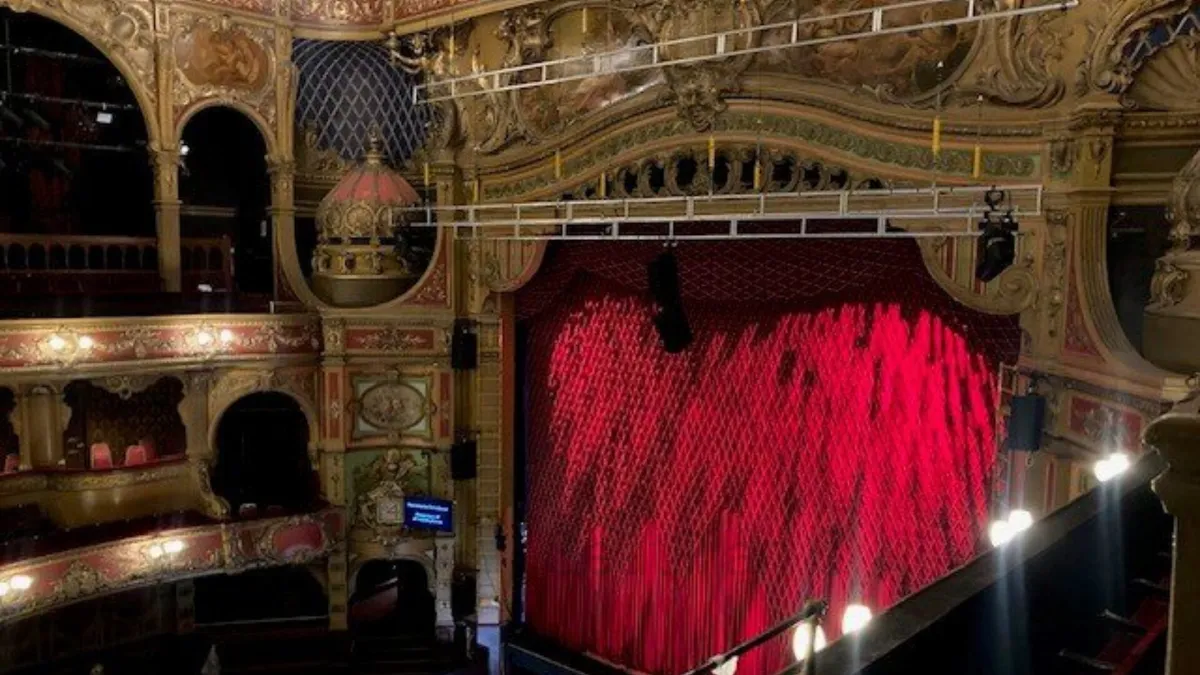 Photo: Hackney Empire, via seatplan.com
Dr. James Whitfield, a former quantity surveyor turned music hall researcher, has spent fifteen years creating digital reconstructions of demolished venues. His latest project focuses on the lost halls of Liverpool's Lime Street district, where six major venues once operated within a quarter-mile radius.
 Photo: Dr. James Whitfield, via drjameswhitfield.com
"We're not just rebuilding buildings," Whitfield insists. "We're reconstructing entire social systems. The music hall wasn't just entertainment — it was education, social club, and political forum rolled into one. Understanding how these spaces functioned tells us something crucial about how culture moves through communities."
Whitfield's reconstructions combine architectural plans with oral histories collected from elderly performers and audience members. The resulting digital models reveal the sophisticated acoustic engineering that allowed comedians to work intimate material to audiences of 2,000, and how gallery seating created distinct social hierarchies within ostensibly democratic spaces.
The Living Archive
Perhaps the most ambitious element of this movement is its commitment to performance archaeology. The Music Hall Research Group, founded in 2019, doesn't just study lost venues — they recreate the performance conditions that made them culturally significant.
In carefully researched events held in surviving Victorian spaces, the group stages authentic music hall programmes using period instruments, lighting techniques, and even atmospheric conditions. The goal isn't historical re-enactment but rather experiential research into how space shapes performance and audience response.
"When you perform 'My Old Man' in a space with the original acoustic properties, with the audience drinking and responding as they would have in 1895, you understand something about the song that you can't grasp from recordings," explains performer and researcher Sarah Maddox. "The comedy, the pathos, the political edge — it all emerges from the relationship between performer, space, and community."
Contemporary Relevance
This obsessive attention to lost performance spaces has gained urgency as Britain's contemporary venue landscape continues to contract. The researchers argue that music halls offer a template for sustainable, community-embedded entertainment that challenges our current assumptions about cultural provision.
Unlike today's arts centres, which often struggle to balance artistic ambition with financial viability, music halls were explicitly commercial enterprises that nevertheless fostered experimental performance and social commentary. Their economic model — combining alcohol sales, diverse programming, and affordable ticket prices — sustained venues for decades while maintaining genuine cultural relevance.
"We're not advocating for a return to Victorian entertainment," clarifies Thornley. "But we are suggesting that the music hall model demonstrates how popular culture can be both commercially viable and artistically adventurous. These venues succeeded because they understood their communities intimately."
Mapping the Future
The music hall researchers have begun collaborating with contemporary venue operators and cultural planners, sharing insights about spatial design, programming strategies, and community engagement. Several new venues have incorporated music hall principles into their architecture and operations, creating flexible spaces that can accommodate both intimate cabaret and larger-scale productions.
Their work suggests that Britain's lost music halls represent more than historical curiosities — they're blueprints for cultural democracy that remain remarkably relevant. In an era when many arts venues struggle to connect with diverse audiences, the music hall tradition offers evidence that entertainment can be simultaneously populist and progressive, commercial and communal.
As these phantom theatres emerge from historical obscurity through digital reconstruction and performance archaeology, they challenge us to reconsider what we've lost and what we might yet recover. The laughter may have faded, but the architectural and social innovations that sustained it for seventy years continue to echo through Britain's cultural landscape.