The Wood Whisperers
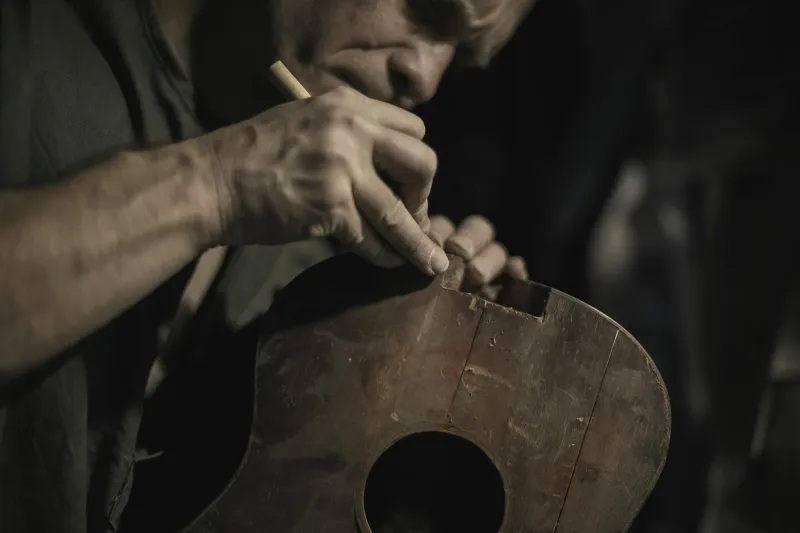
In a converted mill on the outskirts of Hebden Bridge, the sound of careful scraping fills the air as Tom Kellaway shapes a guitar top from a piece of sycamore that fell during Storm Arwen. The wood carries the memory of Yorkshire winds in its grain, and Kellaway believes that history will translate directly into the instrument's voice.
 Photo: Hebden Bridge, via tr-images.condecdn.net
"Every tree that grows in Britain develops its acoustic properties in response to our specific climate, soil, and weather patterns," Kellaway explains, running his hand along the wood's surface. "When you use that timber to build an instrument, you're incorporating centuries of environmental data into the sound. It's like musical terroir."
Kellaway represents a growing movement of British luthiers who have rejected the conventional wisdom that the finest instruments require exotic imported woods. Instead, they're forging a distinctly British approach to instrument making that celebrates local materials while pushing acoustic design into uncharted territory.
Beyond Tradition
The conventional guitar industry remains dominated by designs perfected in Spain, Germany, and America, using wood sourced from rainforests and mountain ranges thousands of miles from Britain. But a new generation of makers is questioning whether those traditional approaches serve contemporary musical needs.
Sarah Chen, whose Bristol workshop specialises in experimental stringed instruments, has spent five years developing what she calls "climate-responsive" designs. Her guitars incorporate seasonal adjustments that allow the instrument to adapt to Britain's unpredictable weather patterns, while her mandolins feature extended fretboards that accommodate the microtonal scales favoured by folk musicians working with traditional British repertoire.
"The standard guitar was designed for music that emerged from different cultural and acoustic environments," Chen observes. "If you're playing British folk music, or if you're exploring the harmonic possibilities suggested by British musical traditions, why constrain yourself to instruments designed for Spanish flamenco or American blues?"
Chen's instruments feature radical departures from conventional design: asymmetrical bodies that optimise projection in small, reverberant spaces typical of British venues; fret systems that accommodate the quarter-tones present in traditional ballad singing; and pickup systems designed to capture the subtle timbral variations that characterise British folk styles.
Material Revolution
The movement's most visible innovation involves the systematic exploration of British timber species that have been ignored by traditional luthiery. Makers like David Antoniazzi in the Scottish Borders have achieved remarkable results using ash from decommissioned cricket bats, oak from demolished Tudor buildings, and even fruit woods salvaged from abandoned orchards.
"British hardwoods have acoustic properties that are completely different from the tropical species that dominate guitar construction," Antoniazzi explains. "Ash gives you this incredible percussive attack, while English walnut produces overtones that seem designed for the kind of fingerpicking techniques you hear in British folk traditions."
Antoniazzi's workshop has become a laboratory for acoustic experimentation, where traditional Scottish fiddle-making techniques are applied to guitar construction, and where the acoustic principles underlying Highland bagpipe design inform the internal bracing of mandolins and bouzoukis.
The environmental implications of this approach extend beyond mere sustainability. By using locally sourced timber, often salvaged from urban tree surgery or storm damage, these makers are creating instruments that embody specific places and moments in time. A guitar built from London plane trees carries the acoustic signature of urban pollution and stress, while instruments crafted from Scottish pine reflect the acoustic properties of highland weather patterns.
Collaborative Innovation
Perhaps the most radical aspect of this movement is its rejection of the traditional relationship between maker and musician. Rather than building instruments to established specifications, many of these luthiers work as collaborators in the creative process, designing instruments specifically to realise musical ideas that existing instruments cannot accommodate.
Composer and multi-instrumentalist Aidan O'Rourke has worked with three different British makers to develop what he calls "conversation instruments" — guitars and mandolins designed to facilitate the kind of musical dialogue that characterises traditional British session playing. These instruments feature sympathetic strings, modified pickup systems, and body shapes that optimise the projection of harmonics and overtones.
"The instrument becomes part of the composition process," O'Rourke explains. "When Tom builds me a guitar with specific harmonic characteristics, those characteristics suggest musical possibilities that wouldn't occur to me with a standard instrument. The making and the music-making become inseparable."
This collaborative approach has produced instruments that challenge fundamental assumptions about acoustic design. Kellaway's recent work includes guitars with moveable bridges that allow real-time pitch adjustments during performance, and mandolins with interchangeable neck sections that permit rapid changes between different tuning systems.
Cultural Reclamation
The movement's broader significance extends beyond acoustic innovation. By developing distinctly British approaches to instrument making, these craftspeople are asserting cultural independence from the global musical instrument industry while creating tools specifically designed to serve British musical traditions.
"We're not trying to build better Martins or Gibsons," Chen emphasises. "We're trying to build instruments that serve the music that's actually being made in Britain today — which includes traditional forms, but also all the hybrid styles that emerge when traditional British music encounters contemporary influences."
This cultural reclamation has attracted attention from musicians working across genres. Electronic producers have commissioned makers to build acoustic instruments that complement digital compositions, while classical guitarists have sought out British-made instruments designed to optimise the projection of contemporary repertoire in modern concert halls.
The result is a rapidly expanding ecosystem of makers, musicians, and music that challenges the assumption that innovation requires abandoning tradition. Instead, these revolutionary craftspeople are demonstrating that the deepest innovations often emerge from the most careful attention to local materials, traditional techniques, and contemporary musical needs.
As their instruments find their way into recording studios, concert halls, and folk clubs across Britain, they're creating new sounds that are both unmistakably British and utterly contemporary — proving that the future of music might well be carved from the timber growing in our own backyard.