The Weight of Permanence
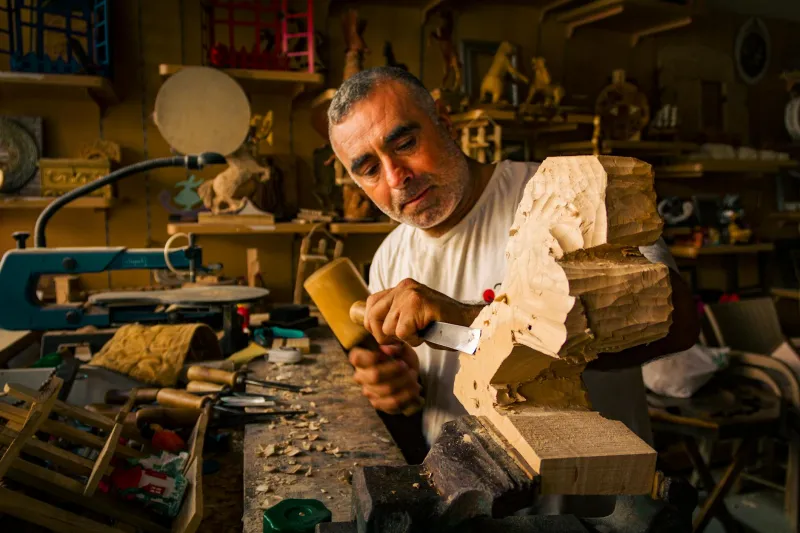
In a dust-filled workshop on the outskirts of Bath, Tom Perkins raises his chisel against Portland stone, each strike creating letters that will outlive him by centuries. The rhythm is hypnotic—tap, tap, tap—as the V-shaped groove deepens with mathematical precision. Around him, half-finished inscriptions lean against walls like fragments of future ruins: memorial stones, architectural lettering, and experimental pieces that push the boundaries of what carved typography can achieve.
"Every letter is a commitment," Perkins explains, pausing to examine the serif he's just completed. "You can't delete it, you can't undo it. Once it's cut, it exists. There's something both terrifying and liberating about that permanence."
Perkins belongs to a diminishing community of British stone carvers who maintain one of humanity's oldest graphic traditions. In an era dominated by ephemeral digital typography, these craftspeople represent a deliberate counterpoint to disposable design culture—their letters measured not in pixels but in millimetres, their durability calculated in geological time rather than software updates.
Ancient Craft, Contemporary Questions
Stone carving in Britain extends back to Roman settlements, reaching artistic peaks during the medieval period when cathedral builders developed techniques that remain largely unchanged today. The fundamental tools—chisel, mallet, and steady hand—connect contemporary practitioners to centuries of predecessors who understood that cutting letters into stone was both practical necessity and artistic expression.
Yet today's carvers work within a radically different context. Where their predecessors served essential communicative functions—creating signs, memorials, and architectural inscriptions in an era before mechanical reproduction—contemporary practitioners must justify their craft's relevance in a world where typography is infinitely malleable and instantly distributable.
"We're not trying to compete with digital type," clarifies Jenny Morrison, whose Cotswolds workshop specialises in architectural lettering. "We're offering something entirely different—typography that exists in three dimensions, that casts shadows, that ages and weathers. It's typography as sculpture."
Morrison's recent projects include lettering for new-build housing developments where developers seek to imbue contemporary architecture with traditional gravitas. Her carved house names and street signs command premium prices precisely because they signal permanence and craftsmanship in an era of rapid change.
The Philosophy of Depth
What distinguishes carved letters from other typographic forms is their relationship to light and shadow. Unlike printed or digital typography, which exists on flat surfaces, carved letters create genuine three-dimensional forms that shift appearance throughout the day as light angles change.
"Typography is usually about the positive space—the letter forms themselves," explains Dr. Sarah Chen, a design historian at Central Saint Martins who studies contemporary craft practices. "With stone carving, the negative space becomes equally important. You're sculpting absence as much as presence."
This dimensional quality has attracted attention from a younger generation of designers frustrated with screen-based work. Several recent graduates from leading design programmes have sought apprenticeships with established carvers, drawn by the craft's physicality and permanence.
Among them is Alex Foster, who abandoned a promising career in digital branding to study with master carver Robert Skelton in the Lake District. "I was designing logos that would be obsolete within five years," Foster reflects. "Stone carving offers the opposite—letters that will remain legible for centuries. There's something profound about contributing to that continuity."
 Photo: Lake District, via a.cdn-hotels.com
Workshops and Transmission
The preservation of stone carving skills depends on informal networks of masters and apprentices scattered across Britain. Unlike other crafts that benefit from institutional support, letter carving exists primarily through individual workshops where knowledge passes directly from experienced hands to novice ones.
Skelton's workshop, housed in a converted barn near Grasmere, exemplifies this model. Here, students spend months learning to read stone grain, understand tool angles, and develop the muscle memory required for consistent letter spacing. The learning process is deliberately slow, emphasising precision over speed.
"You can't rush stone," Skelton observes, watching a student struggle with a recalcitrant piece of Welsh slate. "The material teaches you patience. Modern design culture is obsessed with iteration and rapid prototyping, but stone demands a different approach. You plan carefully, then commit fully."
This pedagogical philosophy extends beyond technical instruction to encompass broader questions about design thinking. Students learn to consider typography's relationship to material properties, environmental context, and temporal duration—factors rarely addressed in digital design education.
Memorial Culture and Contemporary Practice
Much contemporary stone carving serves memorial functions, creating headstones and commemorative plaques that mark significant lives and events. This association with death and remembrance shapes public perception of the craft, sometimes limiting appreciation of its broader artistic potential.
Yet several carvers are expanding beyond traditional memorial work to explore stone lettering's expressive possibilities. In Cornwall, maker Hannah Trelawny creates large-scale installations that combine carved text with landscape intervention. Her piece "Tide Marks" features poetry carved into coastal rocks, designed to be revealed and concealed by changing water levels.
"I'm interested in typography that responds to natural processes," Trelawny explains. "The letters become part of the landscape's rhythm, appearing and disappearing with the tides. It's about finding new contexts for an ancient craft."
Similarly, London-based carver David Park creates architectural interventions that challenge conventional distinctions between typography and sculpture. His carved texts often fragment across multiple stones, requiring viewers to move through space to read complete messages.
The Digital Dialectic
Paradoxically, digital technology has enhanced rather than threatened stone carving practice. Computer-controlled cutting tools allow carvers to rough out basic letter forms before hand-finishing details, whilst 3D modelling software helps visualise complex installations. Several practitioners use digital tools for design development whilst maintaining hand-cutting for final execution.
"Technology should serve craft, not replace it," argues Morrison. "CNC machines can handle the heavy lifting, but the subtle details that give carved letters their character still require human judgement. It's about finding the right balance."
This hybrid approach has enabled carvers to take on larger projects whilst maintaining traditional quality standards. Recent commissions include lettering for major architectural projects where carved inscriptions provide counterpoint to sleek contemporary surfaces.
Future Inscriptions
As interest in craft revival grows across creative industries, stone carving benefits from broader cultural shifts toward valuing permanence and authenticity. Young practitioners bring fresh perspectives to ancient techniques, exploring how carved letters might address contemporary themes and contexts.
The craft's future likely depends on expanding beyond traditional applications to embrace experimental and artistic possibilities. Several carvers are developing collaborative relationships with architects, landscape designers, and public artists who recognise carved lettering's unique aesthetic and symbolic properties.
"We're not museum pieces," insists Perkins, returning to his inscription with renewed focus. "This is living craft that continues to evolve. The challenge is maintaining essential skills whilst finding new ways to make them relevant."
In workshops across Britain, the sound of chisel on stone continues—a rhythmic reminder that some forms of communication transcend technological change. These letter carvers preserve not just technical skills but a different relationship to time, material, and meaning. Their inscriptions will outlast servers, survive software updates, and remain legible long after current design trends have been forgotten.
In an age of digital ephemera, they offer something increasingly rare: words built to last.